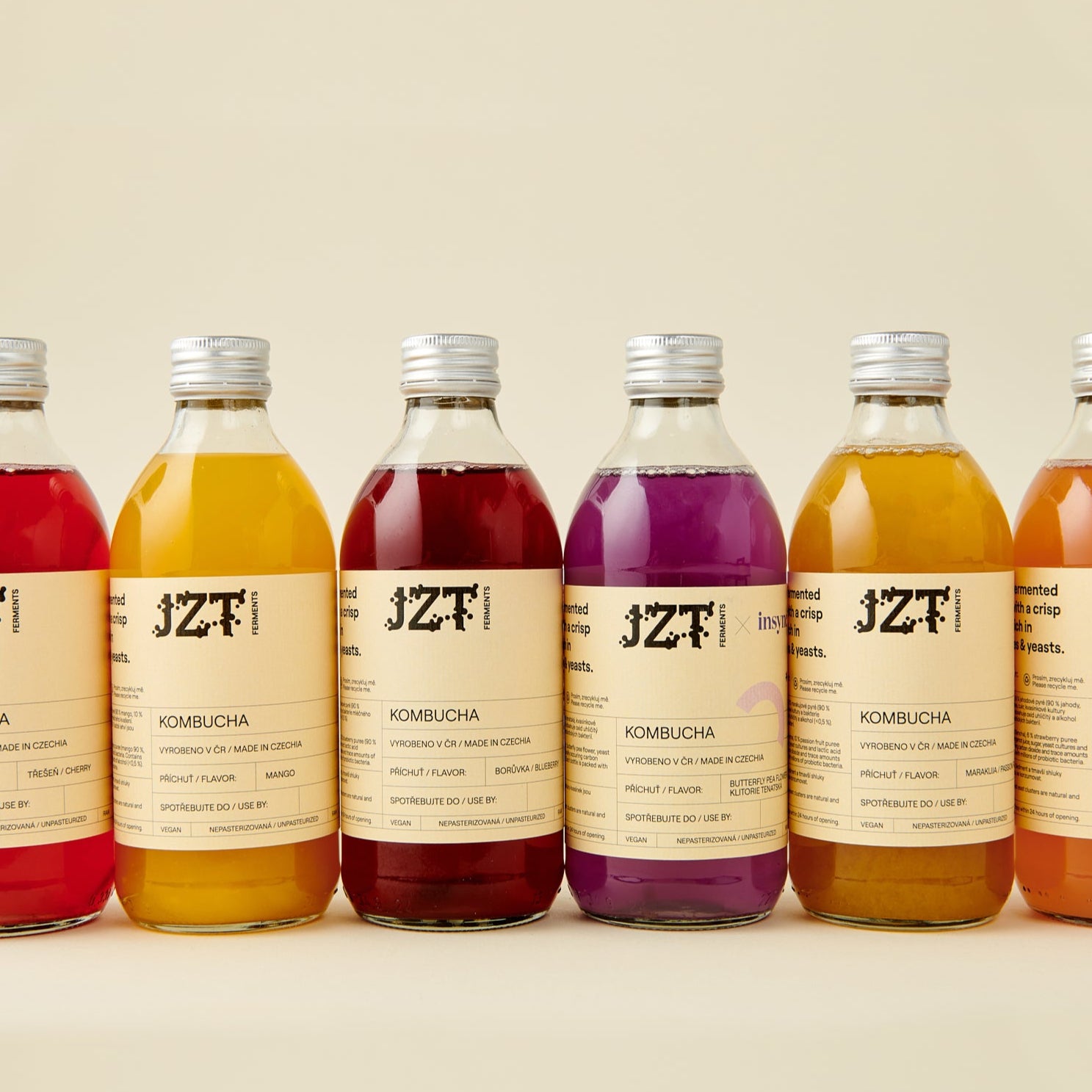
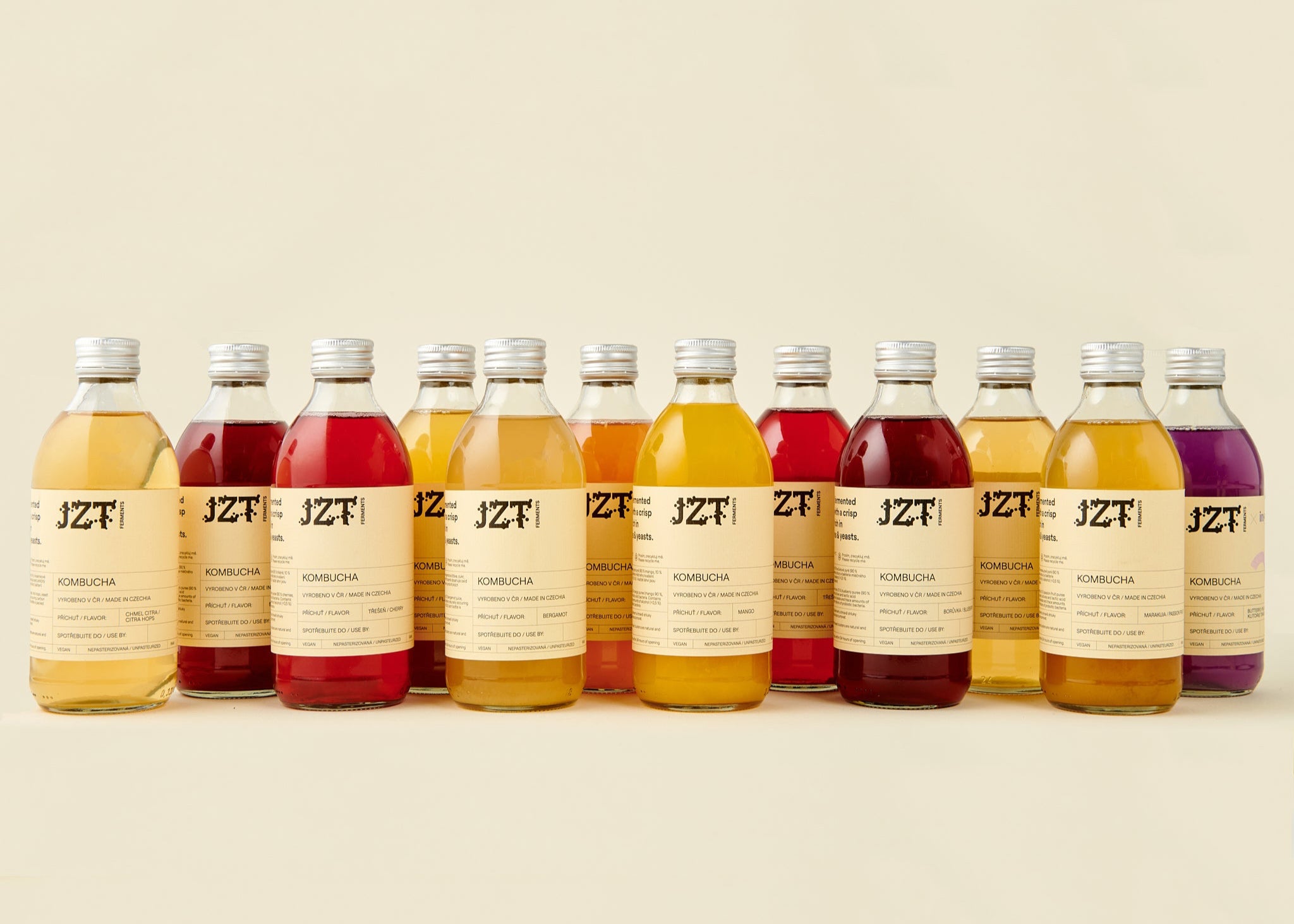
What is kombucha?
What is kombucha
Fermented tea. A sweetened tea infusion to which we add a live culture of yeasts and lactic acid bacteria. Within a few weeks, the culture turns it into a sparkling, tart drink. It is pronounced “kom-boo-cha”. People have been making it for hundreds of years. We make it in Klecany near Prague: from milk oolong tea, for six weeks, without pasteurisation.
How kombucha is made
1. Tea and sugar. We brew a strong tea infusion and sweeten it. Sugar is food for the culture – it uses up a large part of it during fermentation. How much of it is left in the bottle is in the table below and on the label.
2. Culture. We add a SCOBY to the cooled tea. The abbreviation stands for “symbiotic culture of bacteria and yeast” – in our case yeast cultures and lactic acid bacteria, as listed in the ingredients on the label. It forms a cellulose disc on the surface. The yeasts process the sugar, the bacteria turn that into acids. That is where the acidity and the typical taste come from.
3. Time. Six weeks in our case. The longer the culture works, the drier the kombucha and the more complex the taste.
4. Second fermentation. We let the kombucha ferment a second time; for the fruit flavours, purée or juice goes in. This is where the taste of Passion Fruit or Blueberry comes from, and this is where the bubbles come from.
How it tastes
Dry, sparkling, with an acidity roughly like cider and the taste of tea in the background. It is not a sweet lemonade.
OG, Bergamot and Hops are dry and sharp: Hops is also bitter from the Citra hops, Bergamot citrusy with a gentle bitterness. The fruit flavours are juicier and softer: Blueberry is the mildest, Mango the fullest and sweetest. Aura is raspberry, basil and lemongrass.
If the first sip seems sour, take a second one. Most people get used to the taste before they finish the bottle.
How to drink it and what with
Chilled, straight from the bottle or from a glass with ice. At breakfast, at lunch and in the evening, when you fancy something from a bottle, just not alcohol. With food it works like a dry wine: the acidity refreshes the palate and the bubbles suit even bolder dishes.
| Flavour | With food | Moment or drink |
|---|---|---|
| *OG | sushi, fish, hot Thai curry | instead of tonic |
| *Passion Fruit | grilled meat | non-alcoholic spritz with a slice of lime |
| *Bergamot | goat cheese, olives, dark chocolate | in the morning instead of coffee, in the evening instead of a gin and tonic |
| *Strawberry/Bergamot | mascarpone dessert, fruit salad | a picnic or an afternoon on the balcony |
| *Blueberry | breakfast, cheese board | in the evening instead of a glass of wine |
| *Cherry | chocolate dessert, duck | a glass with ice and a sprig of thyme |
| *Mango | curry, Thai food | a drink with chilli and lime |
| *Hops | burger, pizza | the garden after work |
| JZT x Aura | a light lunch | a glass with ice and a basil leaf |
In drinks it replaces tonic or soda – all it takes is a slice of citrus and a herb. You will find specific pairings with each flavour in the e-shop.
What is the sediment at the bottom
Culture. Yeasts and pieces of SCOBY remain in the bottle. Sometimes they look like strands, sometimes like a small disc. It is normal, it is not mould and it is not a defect.
Before pouring, let the bottle stand for a moment so the sediment settles, and pour carefully. If you prefer it dispersed, just gently tilt the bottle and set it back – do not shake, kombucha is sparkling and pressure builds up in the warmth.
Alcohol, caffeine, sugar
Alcohol. It forms naturally during fermentation. We measure it and keep it at up to 0.5% by volume in the bottle. It is a non-alcoholic drink under the same rule as non-alcoholic beer. Outside the fridge, however, the culture keeps working, so keep kombucha cold.
Caffeine. We make kombucha from tea, so it contains a small amount of caffeine.
Sugar. The culture uses up most of the added sugar during fermentation. Depending on the flavour, 3.9 to 6.9 g of sugars remain per 100 ml – most in the flavours with fruit purée, because the sugar from the fruit is added.
Children, pregnancy, breastfeeding. Kombucha is unpasteurised, contains caffeine from tea and up to 0.5% alcohol by volume from fermentation. During pregnancy and breastfeeding, consult your doctor, as with other unpasteurised foods. For children the same applies as for other drinks with caffeine – we leave the decision to you.
How to store it
In the fridge at 2 to 6 °C. Once opened, consume within 24 hours. The use-by date – shown on the label as “Spotřebujte do” – is on every bottle; we ship so that you have at least 7 days left on delivery. In the warmth the culture keeps working: the kombucha gets more sour, more bubbles form and pressure builds up in the bottle.
Myths
“Kombucha is alcoholic.” It contains up to 0.5% alcohol by volume, which forms during fermentation – the same limit as non-alcoholic beer, which is why it is sold as a non-alcoholic drink. It is not completely alcohol-free, though, so bear that in mind.
“It is a mushroom.” In Czech it is called a tea mushroom, but it is neither a mushroom nor mould. It is a culture of yeasts and lactic acid bacteria that forms a cellulose disc on the surface.
“Sediment means it has gone off.” It means it is alive. You recognise spoiled kombucha by mould – fuzzy spots on the surface – or by the smell. In a closed bottle that has been kept cold the whole time this is exceptional; if it did happen, write to us and make a complaint about the bottle.
“It has to taste like vinegar.” That is kombucha that fermented without control or sat in the warmth. Good kombucha is dry with acidity, not vinegar. That is why we measure it, and that is why it belongs in the fridge.
“It is a sweet lemonade.” It is not. The culture uses up most of the added sugar; depending on the flavour 3.9 to 6.9 g of sugars remain per 100 ml and the taste is dry and sparkling.
“It is a medicine.” It is a drink. A good one. That is enough for us.
“It has to be drunk straight away.” In the fridge it keeps until the use-by date on the label, and you have at least 7 days left on delivery. Only an opened bottle needs to be finished quickly, within 24 hours.